Vegetables


 First of all I wish all my readers a Happy Ugadi!!I wish every one will have a wonderful and prosperous year ahead.
Ugadi is a major festival for people staying in Andhra and Karnataka,it is considered as a start of the new year.During childhood we used to get excited for this festival as we get to wear new clothes and savor the heavy festival thali with lots of our favorite goodies.We make 'Ugadi Pacchadi' which is a mix of all the tastes 'shadruchulu' for ugadi which is my favorite among all.I used to ask my mom to make it in a huge quantity so that I can eat it when ever I want through out the day.It is basically a mix of tamarind juice,salt,chopped raw mango,jaggery and neem flowers adjusted according to your taste.
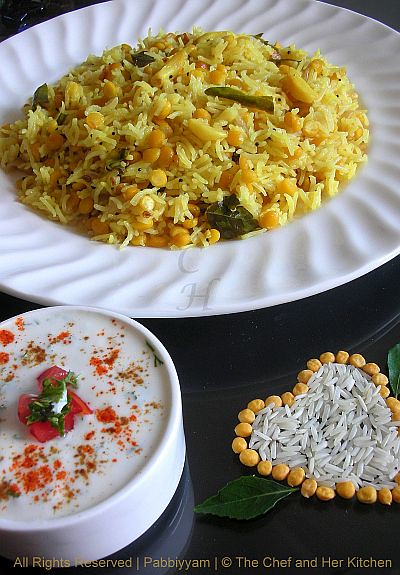
My Ugadi thali menu consisted of ugadi pacchadi,hesaru bele kosambari, cucumber raitha, maavinkaay chitranna, ridge gourd thovve, holige rasam, tomato rasam, urad dal bondas,holiges/obbattu,sago payasam.Me and my friend together planned the menu for the festival and succesfully made everything,I could not take a pic of the final thali how ever you can see the thali I prepared for previous Ugadi festival here.
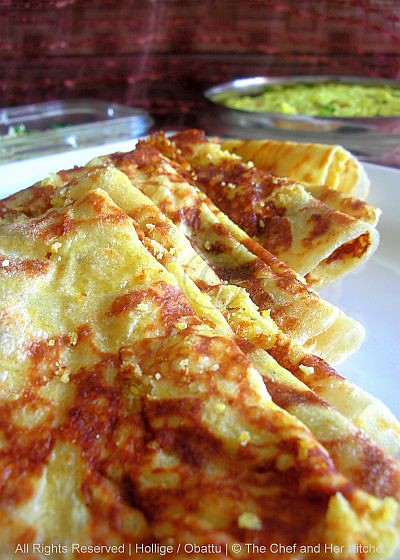
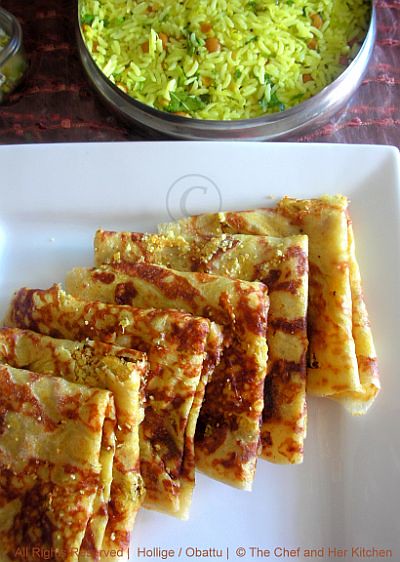
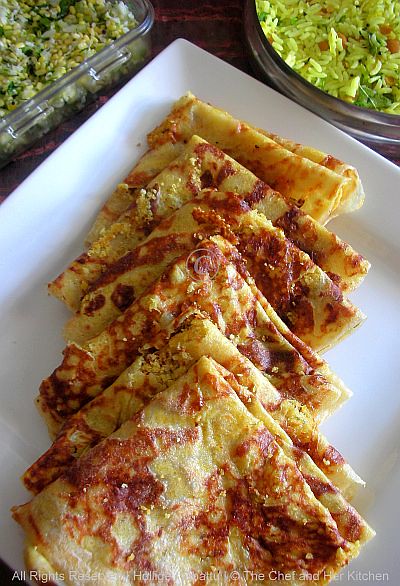
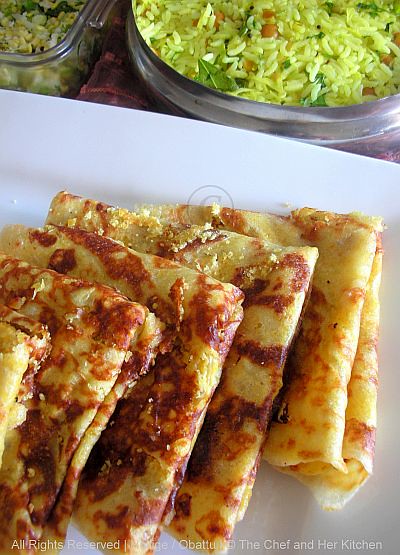
Coming to the festival thali,Ugadi thali is incomplete with out Hollige/Obattu which is the star item for the festival.Holliges are even very common and must sweet in any occasion or marriages.We make various fillings for holige and this hoornada holige/pappu obattu is one among them.It is prepared in various regions of India with many variations. In Maharastra they make some thing similar which is called pooran poli with a wheat flour outer cover and the filling made up of chana dal.I have mentioned in the title 'our community style' because the way we make holige is quite different from the other variations.We use chiroti rawa(very fine rawa) for the outer layer of holiges which gives very soft holiges.We use toor dal for the filling of holiges unlike chana dal which is used in puran poli or any other variations.Even the process of making it is quite different from the others as we do not roll the holige,we instead spread or pat it with hands.These holiges are very very thin and soft and can be folded like hand kerchiefs,they stay extremely soft for long time.It is a very time consuming process and one needs enough practice to master it,but all the effort which u take is quite worthy to savor those delicious holiges.
 Ingredients:
for kanaka(outer cover):
1 cup chiroti/holige rawa(baarik rava)
salt to taste
1/2 cup oil
ghee for frying
for hoorna/poornam:
1 cup toor/arhar dal
1 cup jaggery,grated
1/4 tsp turmeric powder
1/4 cup grated fresh coconut
a pinch of salt
1 tbsp ghee
1/2 tsp elaichi powder
 Method:
for Kanaka:
- Mix chiroti rawa with a pinch of salt to it and add water to it and knead in to a very smooth dough.The consistency of the dough should be very loose than the regular roti dough,this is the most important step otherwise you will not get softer holiges.
- Now using your fist hit the dough for few mins to get the softer dough.It is said that the formula to get a softer holige is to hit the dough 100 times.
- Now place this dough in a deep vessel and pour oil over it until the dough is completely soaked in oil.Let the dough rest for a minimum of 1 hr and upto 2 hrs.Drain the excess oil and use it for other purpose.
- All the steps I mentioned are to be followed without fail to get super soft holiges. See the pics to get to know the consistency of the kanaka.
 for Hoorna/Poornam:
- Wash and soak toor dal for 10 mins.
- Bring 5-6 cups of water to a boil in a deep vessel and add turmeric,salt,ghee and soaked toor dal and let it cook until you feel it is almost cooked.Dal should hold its shape and should be firm,it should not become mushy.Press a grain of dal with your fingers to get to know whether the dal is cooked properly or not.
- Strain this cooked dal over a strainer and let it drain the water and cool completely.Reserve this water to use it in making delicious holige saaru.
- Heat 2 tbsp of water in a kadai and add grated jaggery to it and let it melt over low flame.
- Now add strained toor dal,grated fresh coconut and let it cook along with jaggery until you get a uniform mixture.Now add elaichi powder and mix well and switch off the flame.Let the mixture cool completely.
- Grind to a smooth paste( do not add water) in a mixer and make into a big lemon sized balls and leave them aside.See the pics to get to know the consistency of the hoorna.
 for holige/obattu:
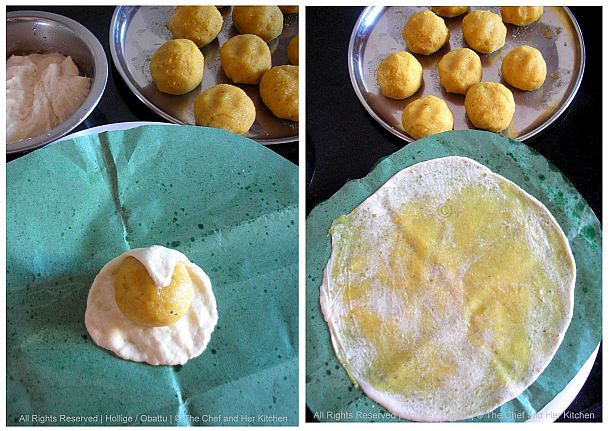
- Cut the holige paper into a round and place it on the rolling stone which we use to roll rotis.Grease holige paper or banana leaf with oil.Cut a thin polythene transparent cover into the same size of the holige paper and clean it and keep aside and grease it one side with oil.
- Pinch a small amla sized dough and flatten it a bit using your hands as shown in the pics and place one round of hoorna and seal it properly from all the edges like how we do for parathas.
- Now flatten it slowly with hands to get 2" diameter circle.Now place a greased thin polythene cover and spread the holige gently using your fingers to get a very thin holige.
- Now remove the greased polythene cover and place the holige paper along with the holige(with holige facing down the tawa)on a hot tawa over the low flame.
- Let it sit for 20-30 seconds and now peel the holige paper gently scraping it along the edges using a spatula.See the pics to get a clear understanding of it.
- Now fry it on both sides applying ghee until light golden in color.Pour the ghee over it,do not try to spread ghee over the holige while frying it.Do not fry it for long time,it will the holiges bit hard so quickly remove it from stove when you get to see the brown patches on it.
- Now quickly fold in it into half and again to half and arrange it in a deep vessel.
- Repeat the process for making holiges,smear the holige paper liberally with oil and follow the same procedure.
Notes:
- These holiges stay good for 2 days and if refrigerated you can keep for 3-4 days.
- For kanaka,you can even add a mix of chiroti rawa and maida in the ration of 1/2 cup chiroti rawa : 1/2 cup maida.
- For a vegan version,use oil while frying holige and also avoid ghee in the filling.